
USDA Loan vs VA Loan: Eligibility and Fees Compared
Compare USDA and VA loan eligibility and fees side by side, including upfront guarantee fees, funding fee exemptions, and property standards.

By Amelia Hayes
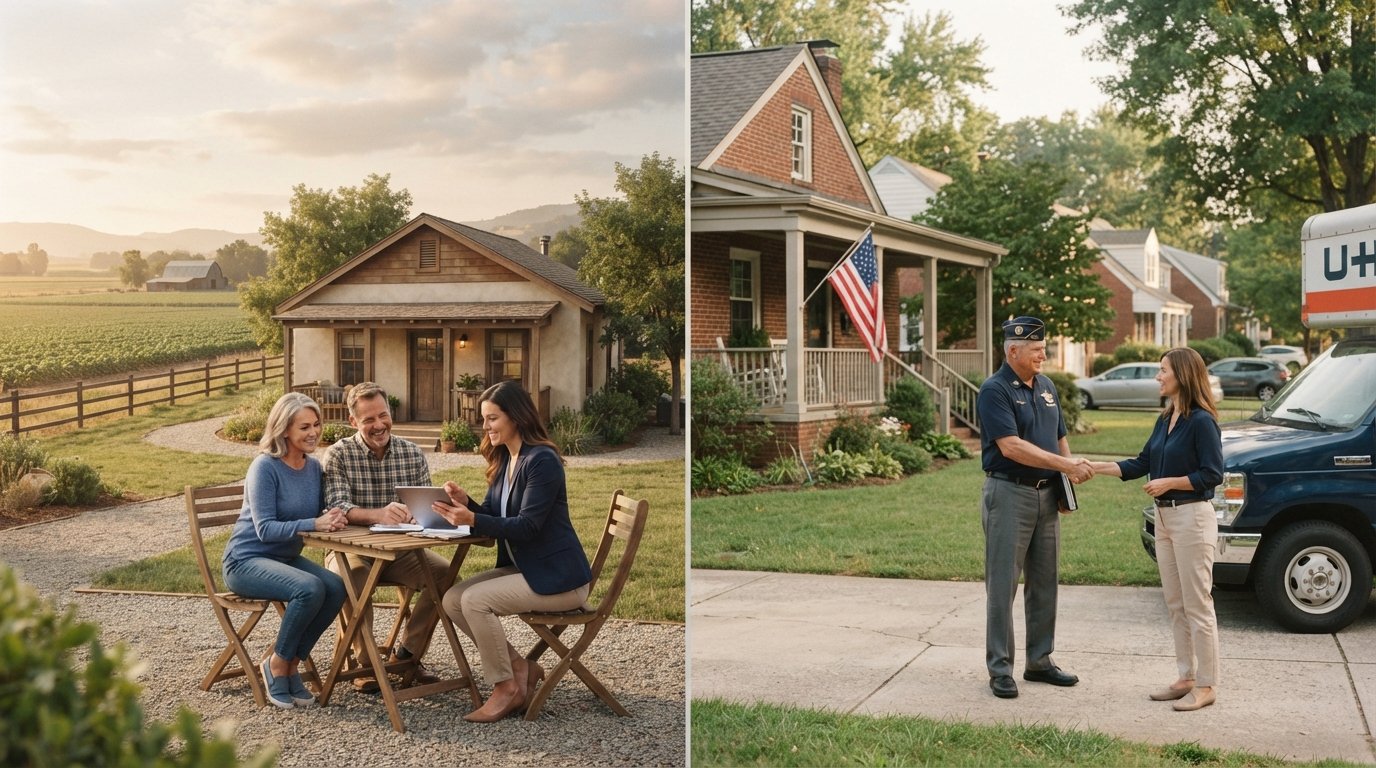
Two of the most generous mortgage programs available to U.S. home buyers come from the federal government, yet they serve very different populations. The USDA loan targets rural and suburban buyers with modest incomes, while the VA loan serves veterans, active-duty service members, and surviving spouses. Confusing the two is common, and that confusion can cost you time or money. This guide compares USDA loan vs VA loan eligibility and fees side by side, explains how upfront costs work, and covers property condition and appraisal differences so you can self-assess which program fits your situation.
Who Qualifies: Rural Area vs Service-Based Eligibility
The USDA loan and the VA loan start from opposite ends of the eligibility spectrum. USDA eligibility is geographic and income-driven. The property must sit in an eligible rural or suburban area as defined by the U.S. Department of Agriculture, and your household income generally cannot exceed 115 percent of the area median income. The program is designed for buyers who want to live outside dense urban centers and who earn moderate incomes relative to their community.
VA eligibility, by contrast, is based on military service, not location. You generally qualify if you served on active duty, in the National Guard or Reserves, or if you are a surviving spouse of a service member who died in the line of duty. There is no income cap for most VA borrowers and no rural area requirement. You can use a VA loan in a major city, a suburb, or a rural town. The VA does require a Certificate of Eligibility, which you can request through the VA or your lender.
Here is a quick comparison of the core eligibility factors:
- Location: USDA requires an eligible rural or suburban area; VA has no location restriction.
- Income: USDA caps household income by area; VA has no standard income limit.
- Service: USDA has no military requirement; VA requires qualifying service or surviving spouse status.
- Occupancy: Both programs require the home to be your primary residence.
One practical takeaway: if you are a veteran living in a rural area and your income is modest, you may qualify for both programs. In that case, the fee structure and property standards become the deciding factors. For a broader overview of how these programs fit alongside FHA loans, see our guide on FHA, VA, and USDA loan programs explained for buyers.
Upfront Fees: Guarantee Fees vs USDA Program Fees
Both programs charge upfront fees, but the structure and purpose differ. The VA loan charges a funding fee, which is a one-time cost that helps sustain the program for future borrowers. The USDA loan charges a guarantee fee at closing plus an annual fee paid monthly. Understanding these costs is essential because they affect your closing cash and your monthly payment.
The VA funding fee varies based on your down payment and whether you have used the benefit before. As of 2026, first-time users typically pay 2.15 percent of the loan amount with no down payment, while subsequent users pay 3.3 percent. A down payment of 5 percent or more reduces the fee. Veterans with a service-connected disability rating are often exempt from the funding fee entirely. The fee can be financed into the loan, so you may not need cash at closing.
The USDA loan charges a 1 percent upfront guarantee fee, which is also typically financed. On top of that, borrowers pay an annual fee of 0.35 percent of the loan balance, divided into monthly payments. That annual fee is similar in spirit to mortgage insurance, though the USDA calls it a guarantee fee. There is no monthly mortgage insurance premium on a VA loan, which is a major advantage for long-term affordability.
To summarize the fee differences:
- VA funding fee: 2.15 percent for first use with zero down; 3.3 percent for subsequent use; can be financed; disability exemptions apply.
- USDA upfront guarantee fee: 1 percent of the loan; can be financed.
- USDA annual fee: 0.35 percent of the loan balance, paid monthly.
- VA monthly insurance: None.
Over time, the absence of monthly mortgage insurance on a VA loan can save thousands of dollars compared with the USDA annual fee. However, the VA funding fee is higher at closing for most borrowers. The right choice depends on how long you plan to keep the loan and whether you can qualify for a VA fee exemption.
Down Payments, Credit, and Debt-to-Income Rules
Both programs are known for low down payment requirements. The VA loan famously offers 100 percent financing, meaning qualified borrowers can buy with no down payment. The USDA loan also offers zero down for eligible buyers, though you must meet income limits and the property must be in an eligible area. Neither program requires private mortgage insurance in the traditional sense, though the USDA annual fee functions similarly.
Credit standards are set by lenders, not just the agencies. VA lenders often look for a minimum score around 620, though some accept lower with compensating factors. USDA lenders typically want a score of 640 or higher, but the program allows for manual underwriting with lower scores in some cases. Debt-to-income ratios also matter. VA generally allows ratios up to 41 percent or higher with residual income analysis, while USDA typically caps ratios around 41 percent unless compensating factors apply.
Here is how the two programs compare on key borrowing terms:
- Down payment: Both offer zero down for qualified borrowers.
- Credit score: VA often more flexible; USDA typically wants 640 or higher.
- Debt-to-income: VA uses residual income analysis; USDA caps around 41 percent with exceptions.
- Mortgage insurance: VA has none; USDA charges an annual guarantee fee.
If you are unsure how these costs translate into a monthly payment, run the numbers with a payment calculator that includes taxes, insurance, and program fees. That exercise often reveals which program is more affordable for your budget.
Property Condition and Appraisal Differences
The property itself can determine whether your loan closes. VA appraisals focus on safety, soundness, and structural integrity. The VA appraiser checks for things like a working roof, adequate heating, and no obvious safety hazards. The VA does not require a termite inspection in every case, but lenders may require one if the appraisal notes evidence of infestation. Importantly, the VA does not mandate a minimum property size or rural location.
USDA appraisals are stricter in some ways. The USDA requires the home to meet certain minimum property standards, and the appraisal must confirm the property is in an eligible rural area. The USDA also requires a termite inspection in many cases, and the property must have adequate access to utilities and roads. Because USDA loans are designed for rural areas, the appraisal often includes a check that the home is not on a working farm or in a commercial zone.
Both programs require the home to be your primary residence. Neither program allows investment properties or second homes. If you are buying a fixer-upper, both programs may require repairs before closing unless the repairs are covered by an escrow holdback or a renovation loan. The VA has a specific renovation option, the VA renovation loan, while the USDA offers a similar program through its guaranteed loan program.
Funding Fee Exemptions and USDA Income Limits
One of the most valuable features of the VA loan is the funding fee exemption for veterans with a service-connected disability. If you receive VA disability compensation, you may be exempt from the funding fee entirely, which can save you thousands of dollars at closing. Surviving spouses may also be exempt in certain cases. This exemption makes the VA loan one of the most affordable mortgage options available for eligible borrowers.
USDA loans do not have a comparable exemption, but they do offer a different advantage: the ability to finance the upfront guarantee fee into the loan. That means you can still buy with zero down, though you will pay the annual fee for the life of the loan. The USDA also offers a streamlined refinance program for existing USDA borrowers, which can reduce the annual fee in some cases.
When comparing USDA loan vs VA loan eligibility and fees, consider your long-term plans. If you plan to stay in the home for many years, the VA loan's lack of monthly mortgage insurance often wins on total cost. If you are not a veteran or if you are buying in a rural area with a modest income, the USDA loan may be your only zero-down option.
How to Self-Assess Which Program Fits
Start by checking your service history and your property location. If you are a veteran or surviving spouse, the VA loan is likely your first stop because of its flexible credit standards and no monthly mortgage insurance. If you are not a veteran, check the USDA eligibility map for your desired area and compare your household income to the area median income limits.
Next, compare the upfront and monthly costs. Use a mortgage calculator to estimate your monthly payment under each program, including the VA funding fee or USDA guarantee fees. Factor in your down payment, closing costs, and how long you plan to keep the loan. A side-by-side estimate often makes the choice clear.
Finally, talk to a few lenders that offer both programs. Lenders can run your scenario through automated underwriting systems and tell you which program you qualify for. They can also explain any overlay requirements that may affect your approval. For a neutral starting point, you can compare quotes from multiple lenders through services like Express Mortgage Quotes, which helps borrowers research options without pressure.
Remember that neither program is universally better. The USDA loan serves rural buyers with modest incomes, while the VA loan serves those who have served the country. Both offer zero-down financing and competitive rates, but their fee structures and property standards differ. By understanding the trade-offs, you can choose the program that aligns with your finances and your long-term goals.